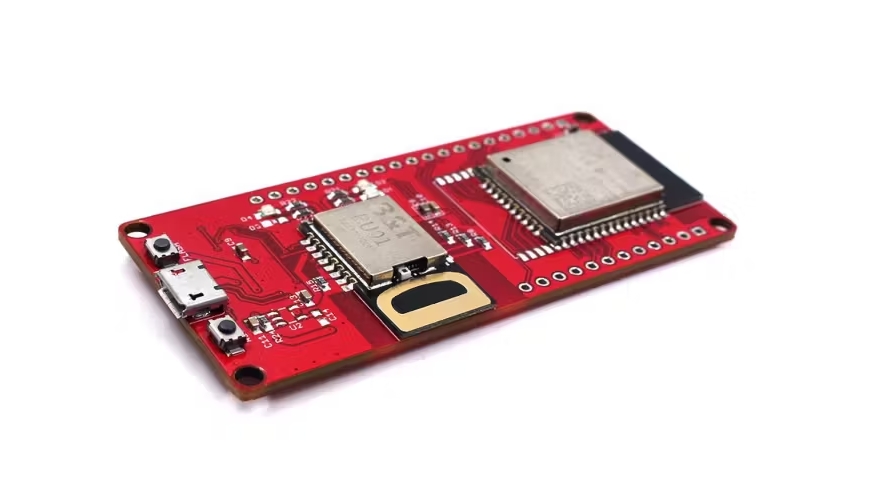
Smart agriculture depends on stable long-range connectivity. Farms cover vast areas, and many sensors operate far from gateways. This environment makes low-frequency wireless technologies valuable. The 433MHz Module stands out because its sub-GHz signal travels farther under the same power level. According to Semtech’s LoRa propagation studies, sub-GHz frequencies achieve up to 3 times the range of 2.4 GHz in open fields due to lower path loss. This advantage shapes many hardware decisions in agriculture. Users need reliable links for soil sensors, irrigation valves, livestock tags, and weather stations. A clear understanding of these requirements helps engineers choose the correct module.
Coverage Requirements in Open Field Deployments
Agriculture sensors may sit hundreds of meters away from the control center. In vineyards, the average sensor spacing is often 200–500 meters, based on data from the California Department of Food and Agriculture’s field tests. Designers must ensure consistent communication across this distance. A 433MHz Module supports long-range performance due to better signal penetration through vegetation and low obstacles. Many modules deliver 1–3 km line-of-sight range with simple antennas. Some high-sensitivity receivers even reach 5 km in open fields. When choosing a module, users should verify its receiver sensitivity rating and modulation type. Both factors strongly affect adequate coverage.
Power Consumption and Battery Life Expectations
Agriculture devices typically rely on small batteries or solar cells. Low power operation is essential. Sub-GHz systems work well in these situations because they transmit efficiently at modest power levels. Typical 433 MHz modules consume 10–30 mA during transmission, while the sleep-mode current can fall below 1 µA. These values align with measurements reported by Texas Instruments and HopeRF for their sub-GHz chipsets. Long battery life supports remote deployments that may not receive frequent maintenance. Engineers should check whether the module supports configurable data rates. Lower data rates often extend range and reduce retransmissions, improving battery life in real projects.
Interference Conditions in Agricultural Environments
Agricultural fields have fewer RF noise sources than cities. However, interference still exists. Weather stations, electric fences, and legacy remote controls may use similar frequencies. The 433MHz band is shared, so users must evaluate local conditions. A sound module should offer multiple channels, frequency hopping features, or adjustable output power. Tests from the European Telecommunications Standards Institute (ETSI) show that sub-GHz systems maintain stable links even under moderate interference when adaptive data rates are used. Users should confirm whether the module supports modulation schemes like FSK or LoRa-like spread spectrum, which improve robustness.

Environmental Durability and Signal Stability
Agriculture exposes hardware to dust, humidity, heat, and vibration. A 433 MHz module must handle these conditions. Many industrial modules operate at –40°C to +85°C, which meets the requirements of most outdoor enclosures. Users should also evaluate antenna compatibility. Antenna tuning strongly affects stability in wet or dense crop environments. For example, tests by Antenova and Taoglas show that moisture on vegetation causes measurable detuning on high-frequency antennas but affects sub-GHz antennas far less. Selecting a module with flexible antenna options ensures continuous performance across winter, summer, and harvest seasons.
Data Rate and Payload Size Considerations
Most agriculture applications do not need high data rates. Soil moisture sensors often transmit only a few bytes every 15 minutes. For such tasks, the typical 2–50 kbps rate of a 433MHz Module is sufficient. Choosing unnecessarily high data rates can reduce range and increase retransmissions. Users should focus on modules with stable low-rate performance and strong error correction. When farms require real-time control, such as automated irrigation, designers should test the module’s latency. Sub-GHz systems typically maintain low latency under low network loads, making them suitable for these tasks.
Practical Deployment Tips for Higher Reliability
Real-world challenges affect wireless performance—placement height matters. Studies from the University of Nebraska–Lincoln Agricultural Research Division show that raising sensor nodes from 0.2 m to 1.5 m can increase link reliability by more than 40% in crop environments. Antennas should sit clear of metal surfaces. Gateways should occupy central, elevated positions. A well-designed network topology, combined with a high-quality 433 MHz module, reduces packet loss and simplifies system maintenance. Users should also perform pre-deployment range tests across different seasons, as crop density can change the RF environment.
Choosing the Right 433MHz Module for Smart Agriculture Projects
A reliable 433 MHz module enables long-range, low-power, and interference-resistant communication across broad agricultural areas. Users should evaluate key factors such as range performance, power consumption, environmental durability, and modulation support. Innovative agriculture systems benefit from stable sub-GHz connectivity, and a well-selected module ensures efficient data collection and long-term field reliability. By understanding real requirements and verifying technical parameters, users can confidently choose the right solution.